
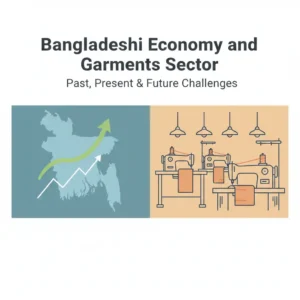
The focal point of this development is the Ready-Made Garments (RMG) industry. It drives exports. It creates jobs.The Bangladeshi economy and garments sector are the two aspects that are intertwined. It assists the families of millions of people.
Nevertheless, it has become a large challenge to Bangladesh. Garments are over-reliant in the economy. This exposes the country to world shocks. It is time to plan Bangladesh to be diversified and stable in the long run.
Bangladesh Economics: The History
Bangladesh was plunged in a state of extreme economic depression after gaining independence in 1971. The roads, bridges, and industries were destroyed in the war. Poverty was extremely high. The economy relied on agriculture and foreign assistance.
The garments sector began to develop in the late 1970s and early 1980s. The industries were able to grow fast due to global trading opportunities and cheap labor.
Bangladesh had less than 50 garment plants in 1984. There are over 3,500 garment manufacturing factories which today are export oriented.
Bangladesh also improved significantly with time:
-
The poverty dropped to less than 20 percent in the recent years whereas the poverty levels were approximately 44 percent in 1991.
-
The increase in GDP slowly increased to be above 6% at prolonged periods.
-
The level of female employment improved.
-
The jute gave place to garments as the primary export product of the country.
The emergence of the garments industry transformed the economy of Bangladesh.
The Economy of Bangladesh Nowadays
Bangladeshi economy and garments sector is the key of the country’s development. In the present day, Bangladesh is also amongst the rapidly developing economies in South Asia.
The GDP of the country has risen to over 460 billion. Per capita income has gone beyond 2500 dollars. Until the COVID-19 pandemic, Bangladesh has been recording above 7 percent GDP growth over the past few years.
Bangladesh is also getting ready to graduate as LDC in the year 2026. It is a significant progress. It tells of income, education and development indicators.
Nevertheless, the export dependency is a grave problem. Clothing continues to have the export economy.
Role of Bangladeshi Economy and Garments Sector
The contribution of garments sector to the economy is enormous.
Here are key facts:
-
The garments industry accounts to over 80 per cent of the Bangladesh export revenues.
-
The garment exports amount to approximately 45-47 billion per annum.
-
The industry has approximately 4 million employees.
-
Almost 60 percent of the garment workers are females.
-
Bangladesh is also ranked as the second largest garment exporter in the world following China.
The clothing industry is a multi-million dollar industry where millions of people are both directly and indirectly employed. It has assisted in augmenting foreign exchange reserves of Bangladesh. It also favored fast urbanization in Dhaka, Gazipur, Narayanganj and Chattogram.
Bangladesh is also the leader in sustainability. The number of LEED-certified green garment factories in the country is more than 150, which is the most in the world.
This is a significant success of the industry.
Challenge of Single Product Economy
Overreliance on a sector is the largest threat in the Bangladeshi economy at the moment.
The economy is weak when more than 80 percent of the exports are in the form of garments.
Here are the major risks:
1. Global Demand Shock
Export orders are reduced rapidly in case the United States or the European Union is experiencing recession. This impacts directly on Bangladesh.
2. Price Pressure
Low cost is the competition strategy in Bangladesh. Various consumers demand low prices. This maintains low profit margins.
3. Limited Product Range
Bangladesh continues to export largely more simple clothes such as T-shirts, trousers, and sweaters. The values of technical garments are still high.
4. LDC Graduation Impact
Bangladesh could lose part of its duty-free market after 2026. This has the potential of decreasing competitiveness in international markets.
The economy of single product is not able to guarantee long-term economic stability.
Future Obstacles of Bangladesh Economy
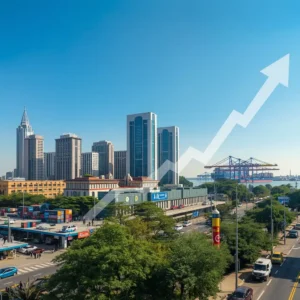
Bangladesh has been going through a new stage. The economy has some challenges that will be experienced.
Foreign Exchange Pressure and Inflation
The increase in global energy prices and food prices increased the cost of imports. There was pressure on foreign currency reserves.
Energy and Infrastructure Lapses
The economic development of industries requires the apt supply of electricity and gas. Cost of production is enhanced by energy shortage.
Robotization and Professional Training
Multinational brands are laying money in automation and digital technology. Bangladesh needs to modernize the skills and production technology.
Climate Change Risk
Bangladesh is a highly climate-vulnerable nation in the world. Disruption of production and destruction of infrastructure by floods and cyclones is possible.
Financial Sector Weakness
There is need to have banking reforms. Financial stability is diminished by defaults in loans, and regulations.
Such predicaments need intelligent policy and long-term planning.
Economic Diversification Requirement in Bangladesh
The garments industry and Bangladeshi economy have to develop simultaneously. Bangladesh does not have to decrease garments. In its stead, it will have to construct new pillars of export.
Bangladesh is highly promising in a number of sectors:
-
Pharmaceuticals (exports to 150+ countries)
-
ICT and freelancing
-
Leather and footwear
-
Agro-processing
-
Light engineering and shipbuilding.
-
Blue resources and oceans.
Diversification will have significant advantages:
-
Reduced export dependency
-
Higher-value production
-
More skilled jobs
-
Better economic capacity.
An economy that is diversified is more resilient to shocks in the world.

Prospective of Bangladesh’s Economy and Garments
Bangladesh needs to change to create a future.
In the case of the garments industry, Bangladesh ought to:
-
Repackage to high-value and technical clothes.
-
Make investments in automation and new supply chains.
-
Develop Bangladeshi brands
-
Enhance sustainability and compliance leadership.
To the national economy, Bangladesh is supposed to:
-
Enhance education and vocation.
-
Promote foreign direct investment (FDI)
-
Expand export markets
-
Revamp financial institutions and regulation.
Providing that Bangladesh copes with this shift, the country can become a part of upper-middle-income nations in ten years.
Conclusion
The history of the economy and garment industry of Bangladesh is a history of development and survival. Millions of jobs were created by the garment industry. It helped reduce poverty. It empowered women. It strengthened exports.
Nevertheless, the reliance on a single industry is a weakness. At a crossroad, Bangladesh is situated. The nation needs to modernize the clothes sector and venture into other industries.
Bangladesh has already demonstrated that it can develop despite all the odds. This time it has to demonstrate that it can become smarter.
Frequently Asked Questions (FAQ)
It may be designed using Frequently Asked Questions (FAQ), which are queries that emerge frequently and appear on the first page of the website.
How does the garments sector contribute to the Bangladesh economy?
The garment industry brings in more than 80 percent of the total export revenues in Bangladesh, and it also has approximately 4 million employees.
What is the reason why Bangladesh relies on the garment industry?
Bangladesh found itself competent in the low-cost clothing production. Garments ended up being the primary driver of the export in the country.
What are the challenges of a single-product economy?
A single-product economy faces high risk from global demand shocks, price pressure, and trade policy changes.
Why does Bangladesh need economic diversification?
Diversification reduces export dependency, increases economic stability, and creates high-value employment opportunities.

Very good articles