
The Ready-Made Garment (RMG) industry of Bangladesh is not an industry but the engine of the export-based economy of the nation. The industry has developed to be one of the most significant apparel sourcing centers in the world which has started as small stitching units all the way to world-class compliant factories.
However, being fair enough, the situation at hand is not quite as easy as it was 10 years ago.
Bangladesh is currently working in a global market whereby the buyers are requiring reduced prices, quicker delivery, enhanced compliance, and sustainability simultaneously. Besides that, the local industry is struggling with increasing operation costs, energy insecurity, narrowed margins, and increasing competition by other sourcing nations.
Thus, what is the situation of the Bangladeshi garment industry? What are the major issues that are defining it? And how does the SWOT analysis look into its future?
This article will deconstruct the current situation, current state, and issues and realistic SWOT analysis in a manner that can be easily comprehended as well as truly helpful to factory owners, merchandisers, sourcing professionals, and RMG learners.

The Bangladesh Garment Industry (2026): Present Scenario
The market in the present RMG is like a balancing act. The orders are still coming to Bangladesh, the volumes continue to be produced in large quantities and Bangladesh continues to be a supplier worldwide. However the character of those orders- and the conditions which are connected with them- have become very different.
1) Purchasers are more selective than ever
Fearing a decade of uncertainty on the global front, there are various fashion brands and retailers who are now conservative in their stock. They do not take large long-term orders; in most cases, they are just ordering small quantities of items and they are decentralizing orders to a number of suppliers.
It implies that the factories will need to struggle to receive steady work.
2) Lead times are getting shorter
Buyers in most instances desire shorter lead times than what the traditional one in Bangladesh offers. The demands on fast fashion and seasonality have been more acute. There is less tolerance of delays in sampling, approvals, sourcing of raw materials and shipping.
Quickly responding factories are becoming the preferred suppliers and the slower responding suppliers are losing long term opportunities.
3) There is an increase in compliance and transparency
This time round compliance is not only passing an audit in 2026. Buyers are seeking harder substantiation of:
- worker well-being
- ethical wage practices
- clean HR documentation
- fire and building safety
- chemical management
- environmental responsibility
- traceability and transparency
This change is driving factories towards greater expenditure on systems, individuals, and records.
4) Sustainability is no longer an option
Sustainability is no longer a nice marketing slogan, it is also a business need. Buyers are demanding factories that have demonstrated improvement in:
- lowering water and energy consumption
- managing waste properly
- working with green raw materials
- using less hazardous dyes and chemicals
- satisfying international sustainability standards
Bangladesh has been fully evolving green factories, although a lot of suppliers are still required to improve on their practices in order to be competitive.
Present Position: Bangladesh in the Modern World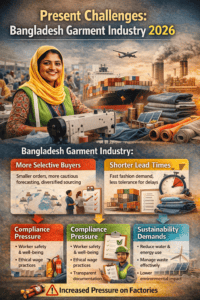
In spite of the pressure and the shifting expectations of buyers, Bangladesh is one of the most powerful apparel sourcing countries in the whole world. The nation still remains one of the best destinations of brands requiring quality production on a large scale.
Bangladesh is still powerful in the core product categories
Bangladesh is especially good in:
- knitwear (t-shirts, polo shirts, leggings, loungewear)
- basic woven garments
- denim and jeans
- casualwear
- underwear and innerwear
- large-volume repeat orders
This is where the country has gained the experience and efficiency over the years.
Supplier ecosystem is developed
The fact that Bangladesh has established a powerful supporting ecosystem is one of the greatest assets:
- spinning mills
- knitting factories
- dyeing and finishing units
- laundering facilities (denim in particular)
- suppliers of trims and accessories
- suppliers of packaging and labeling
- compliance and testing services
It is this ecosystem which has led to several factories being able to conduct end-to-end operations in a more efficient manner than the newer sourcing nations.
In some respects Bangladesh is also a sustainability leader
It is generally known that Bangladesh is a country with numerous green garment factories around the world. There are examples of factories which are truly leading in:
- energy-efficient production
- wastewater treatment
- worker-friendly environments
- LEED-certified buildings
This reputation assists the country to keep sustainability-driven brands.
But the thing is: profit margins are on the run
Although Bangladesh is producing and exporting on a large scale, there are numerous factories that make problems in profitability. In the present case, the earning of profit does not necessarily involve winning of orders.
Factories that are being improved make the true winners:
- productivity
- planning accuracy
- quality performance
- line efficiency
- communication speed
- cost control
The Critical Issues in the Bangladesh RMG Industry
What about the largest challenges, in everyday, lay, language, without being a company?
1) Cost vs Buyer Price Negotiation
The following is one of the most painful facts to factories:
The price of the local costs is on the increase yet the buyers demand low FOB.
The factories are experiencing increased cost of:
- wages
- utilities
- compliance systems
- chemical management
- raw material sourcing
- banking and finance
- maintenance and spare parts
However, customers tend to compare the prices in Bangladesh with those of other competitors and demand reduced prices.
This does cause a squeeze in the margin. A large number of suppliers will accept orders at low profit just to continue with the production.
2) Energy & Utility Uncertainty
The provision of energy has turned out to be a significant operational risk. Unreliable gas supply, electricity swings and increasing cost of utilities may impact:
- daily production output
- machine performance
- overtime planning
- delivery schedules
- overall factory efficiency
The factories are now putting money on backup systems and machinery that consume less energy and alternative sources of energy- however this involves investment.
3) Lack of Productivity at most of the factories
The factories are of world standard in Bangladesh, but there are numerous mid-range factories that are still grappling with productivity.
Typical issues in productivity are:
- weak line balancing
- poor SMV analysis
- high rework percentage
- bottlenecks in sewing lines
- inefficient factory layout
- practices in limited IE (Industrial Engineering)
- inability to track the production in real-time
The truth is:
One of the quickest methods of defending the profit, but without raising the prices of buyers, is the productivity.
4) Pressure of Compliance and Expectations of the Workers
The standards of compliance are increasing all over the world, and the workers themselves are increasingly conscious of their rights and demandingness.
Factories nowadays have to pay attention to:
- safe working conditions
- compliance with wages and proper pay roll
- proper overtime management
- respectful HR practices
- grievance and worker engagement systems
- just recruitment and work practices
A single compliance problem can result in the cancellation of orders, a tarnished image, or an irreversible loss of a consumer.

5) Long Lead Time and Supply Chain Problems
One of the greatest problems has been lead time, particularly in the woven and fashion products that require imported raw materials.
The causes of delay are some of the largest and include:
- import lead time of the raw material
- slow sampling approvals
- lab delays and shade equivalent alike
- lacks and accessories shortages
- port congestions or logistical delays
- fit sample buyer approvals received late
The factories, which are capable of minimizing internal delays and accelerating communication are attaining a good competitive advantage.
6) Low Product Diversification in High-Value Product Line
Bangladesh is fine in fundamentals. The world market is, however, shifting to more sophisticated and value products like:
- sportswear and activewear
- outerwear and jackets
- functional garments
- performance fabrics
- technical sewing and attachment of things
Factories require to expand in the following categories:
- advanced machinery
- skilled technicians
- powerful product development units
- increased ability to obtain better fabrics
- technical knowledge and training
In the absence, Bangladesh will remain confined to low-margin basics.
The Garment Industry in Bangladesh SWOT Analysis
One of the most viable tools to learn about the industry is a SWOT analysis. It assists in determining what Bangladesh is doing well, what it is not and what opportunities it has and what threats can affect development.
Strengths (What Bangladesh Does Well)
There are a number of strengths that enable Bangladesh to remain competitive in the world:
✅ 1) International brand of mass production of apparel
Bangladesh is also reputed of handling big volumes of orders, particularly of simple clothes.
✅ 2) Good knowledge in knitwear and denim
The nation is highly skilled, has machines, and supply chain in these areas.
✅ 3) Mature supplier ecosystem
Bangladesh has developed a good network of ancillary industries, starting with fabric, trims and packaging.
✅ 4) Developing sustainability leadership
Numerous factories have taken investment in green buildings and clean production systems.
✅ 5) Talented labor force in core business
The country of Bangladesh has a massive labor force, experience in sewing, finishing, and quality systems.
Weaknesses (Where Bangladesh Needs Improvement)
Despite the good underpinnings, Bangladesh has its drawbacks that it should work on:
❌ 1) Reliance on foreign raw materials
A lot of high value fabrics, synthetic fabrics and technical countries are yet to be imported.
❌ 2) Productivity/efficiency discrepancies
Not every factory can work according to international efficiency rates, which influences the profitability.
❌ 3) Low advanced product development competence
Several suppliers cannot shift to the more value-added segments because of the skill and technology differences.
❌ 4) Long lead time as compared to certain competitors
The issue of speed is also growing larger, and Bangladesh needs to enhance the planning and supply chain coordination.
❌ 5) Negotiating power and pressure on margins are weak
Competition and uncertainty of the orders make many suppliers take low-profit orders.
Opportunities (Where Growth Can Come From)
The future does not only entail problems. The opportunities of Bangladesh are high:
1) Sustainable sourcing programs development
Increasing numbers of buyers are developing supplier lists of preference on sustainability and compliance. Here, Bangladesh can win more of the long-term alliances.
2) Growth to artificial fabrics and textile recycling
The entire world is demanding polyester blends, recycled fabrics, and functional materials. Bangladesh can make an investment in this segment.
🌟 3) Digitalisation of factory work
ERP, production tracking, PLM, and real-time dashboards will enhance product efficiency and decrease product latent loss.
🌟 4) Adding more value by developing the product
Factories investing on design support, sample rooms and technical development are able to get better margins.
🌟 5) Excellent buyer relations by transparency
When the factories report correctly, are traceable and ethical, they will win the trust of buyers and business longevity.
Threats (What Can Harm Growth)
Bangladesh also should not ignore the dangers of the outside world:
Danger 1) Competitors to other sourcing nations
The other nations are enhancing their ability and giving good incentives to customers.
⚠️ 2) Global demand slowdowns
Economic uncertainty may cause retail demand to decline, which impacts on order volume.
⚠️ 3) Increasing compliance standards
Failure in compliance may result into buyer loss or severe punishment.
Warnings 4) Geopolitical risks and disruptions in logistics
Supply chains can be derailed by shipping routes, freight costs and international conflicts.
5) Climate and environmental risks
Factories may suffer the effects of flooding, heat waves, and environmental regulations that may influence the cost structure and operation.
What Factories Should Work on Now (Practical Recommendations)
As an owner of a factory, merchandiser, or leader of a production, the following are the practical actions that can have the biggest impact, should you be one of them:
1) Enhance productivity and then increase capacity
Profits can be made in an easier way than new investment.
Focus on:
- line balancing
- SMV-based planning
- reducing rework
- quality improvement systems
- better layout and workflow
2) Enhance planning and communication
Unplanned losses are losses that are hidden.
Improve:
- TNA tracking
- sampling follow-up
- approval management
- production scheduling
- shipment coordination
3) Build long-term buyer trust
Today, the market is inclined to use suppliers that can be seen and are the same.
Focus on:
- compliance documentation
- ethical HR systems
- traceability
- clear production reporting
4) Smart diversification, not blind diversification
Rather than attempting to build capability in all products, select 1-2 product lines that your factory can successfully develop and make a greater margin.
FAQs
1) Will Bangladesh remain a good garment sourcing destination in 2026?
Yes. The Bangladesh sourcing center continues to be one of the best sourcing centers particularly when it comes to large volume purchases in key product lines such as knitwear and denim. But buyers now would select factories that have a good compliance level, sustainability development, and good quality delivery.
2) What is the current largest weakness of Bangladeshi garment factories?
The greatest challenge is that of margin pressure. Prices are going up in the area but customers tend to demand better FOB prices and also demand quicker delivery and increased compliance.
3) What are the strengths of Bangladesh in products?
Bangladesh is the best in knitwear, basics, casual wear, denim, and high volume repeat orders. Most of the factories are upgrading in the value added goods, yet sophisticated categories involve investment and technical expertise.
4) How would a factory be able to increase profitability without order volume?
Improvement of productivity is the quickest method. A higher efficiency of the line, less rework, excellent planning of SMV, and high production tracking can considerably drive the profit even without increasing prices.
5) What is the significance of sustainability to the garment industry?
The significance of sustainability is that people in the buying and consumer levels require responsible manufacturing. Companies are becoming more choosy about their suppliers; they favor those who have favorable environmental performance, are safe in terms of chemicals, and have ethical working standards.
Conclusions: The Future of Bangladesh RMG
The garment industry remains one of the most powerful at the global scale, although the market is evolving rapidly in Bangladesh. The old model of a high volume and low cost is not sufficient anymore.
The following phase of success will be determined by:
- productivity and efficiency
- good planning and performance in delivering
- compliance and transparency on ethics
- sustainability readiness
- prudent diversification to more desirable segments
The positive aspect is that Bangladesh already demonstrated that it can change. Having the right strategy, the country can be one of the global leaders in the supply, as well as in value.
We exchange experience in merchandising, production, compliance, factory efficiency as well as the real-life RMG improvement strategies in RMG Pro 360. Connect and receive further industry insights and actionable guides.