
Introduction
Look at the label on your shirt for a moment.
“Produced in Bangladesh.”
Most of the time, we don’t really pay attention to it. But that small line carries a much bigger story. The history of Bangladeshi garments is not just about factories and exports—it is about people, persistence, and progress.
This article explores the journey of Bangladesh’s Ready-Made Garment (RMG) industry, from its early days to where it stands today, and where it is heading next.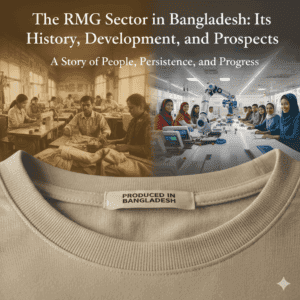
The Early History of Bangladeshi Garments
In the late 1970s, Bangladesh was still heavily dependent on agriculture. Moving into garment manufacturing was a risky decision at that time. There was little experience, limited infrastructure, and almost no exposure to international apparel markets.
A major turning point came in 1979, when Nurul Quader Khan, the founder of Desh Garments, sent 130 workers to South Korea to receive training from Daewoo. Many of these workers had never even seen a sewing machine before.
When they returned, they brought back more than technical skills. They introduced factory discipline, modern production methods, and a new mindset. Many of them later went on to establish their own factories. This single initiative planted the seed for what would become Bangladesh’s massive garment industry.
How the RMG Sector Became the Backbone of the Economy
Today, the garment industry plays a central role in Bangladesh’s economy.
- It contributes around 11–13% of GDP
- It generates more than 84% of export earnings
- It employs around 4 million workers
More than half of these workers are women. Their income supports families, improves education, and strengthens rural communities. This impact goes far beyond factories—it creates what economists call a multiplier effect, helping to build a growing middle class.
This is one of the most important chapters in the history of Bangladeshi garments.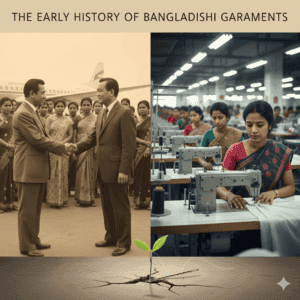
Growth During the 1990s: Learning While Expanding
The 1990s were a period of rapid expansion for the RMG sector. Growth came with challenges, but the industry learned as it moved forward.
Two systems played a key role:
1. The Quota System (Multi-Fibre Arrangement)
This system gave Bangladesh secure access to US and European markets, helping local factories compete globally.
2. Back-to-Back Letter of Credit (LC)
This allowed factory owners to purchase raw materials on credit once they received confirmed orders. As a result, many entrepreneurs could start businesses without large initial capital.
Together, these systems helped the industry grow faster than expected.
Major Challenges and Industry Transformation
The journey of the Bangladeshi garment industry has not been easy.
The Rana Plaza tragedy in 2013 was one of the darkest moments in this history. Earlier, the industry also faced criticism over child labor during the 1990s.
What followed, however, was a major transformation.
- Children were removed from factories and sent back to school
- Workplace safety regulations became stricter
- Large-scale safety reforms were implemented after 2013
Today, Bangladesh has one of the highest numbers of LEED-certified green garment factories in the world. The industry turned crisis into reform, setting new global standards for safety and sustainability.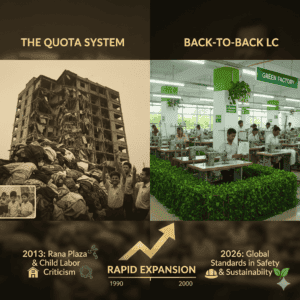
Technology and the Future of Bangladeshi Garments
The next phase in the history of Bangladeshi garments is being shaped by technology.
We are now entering the era of Industry 4.0, where digital tools and automation are changing how garments are produced.
Key developments include:
- Smart sorting machines that reduce fabric errors
- AI-based industrial engineering planning to reduce material waste
- 3D sampling that allows buyers to review designs in minutes instead of weeks
Automation is not about replacing people—it is about improving efficiency, safety, and quality in a fast-moving global fashion market.
What Comes Next for Bangladesh’s Garment Industry?
Bangladesh should not remain only a manufacturing hub.
The future lies in:
- Building Bangladeshi fashion brands
- Expanding presence on global high streets
- Investing in sustainability and circular fashion
One promising initiative is recycling fabric waste, locally known as “jhoot,” into high-quality yarn. This supports a circular economy and reduces environmental impact.
Conclusion
The history of Bangladeshi garments is a story of turning uncertainty into achievement.
From a small training program in South Korea to becoming a global leader in green manufacturing, Bangladesh has come a long way. And this journey is still continuing—driven by people, innovation, and resilience.